
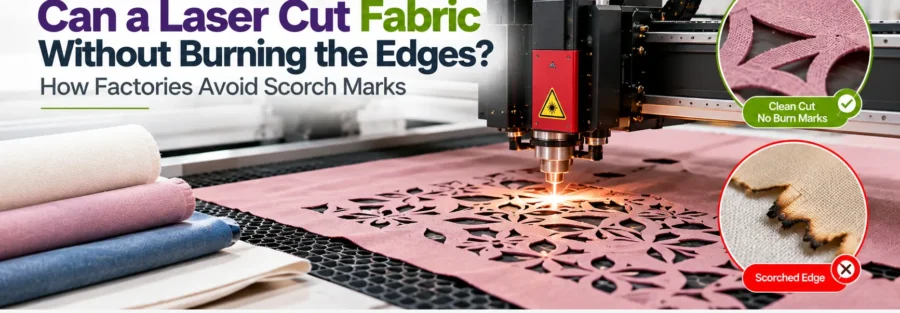
Yes, a laser can cut fabric without visible burning, as long as the fabric suits laser cutting and the settings are right. Synthetic fabrics like polyester and nylon cut with a clean, sealed edge on a CO2 laser cutting machine. Natural fibres like cotton and silk can be cut with minimal browning by using lower power, higher speed, steady air assist and good extraction. Factories avoid scorch marks by matching power and speed to the fabric, not by turning the laser down blindly.
Ask anyone who’s run a laser on fabric and they’ll tell you about the first batch. Brown edges on white cotton. A yellow line on a pale silk panel. Smoke marks on the back of polyester.
Most of that comes down to settings and setup, not the machine itself. This guide covers why fabric scorches, which fabrics resist it, and the practical steps factories use to keep edges clean on every piece.
Why does fabric scorch during laser cutting?
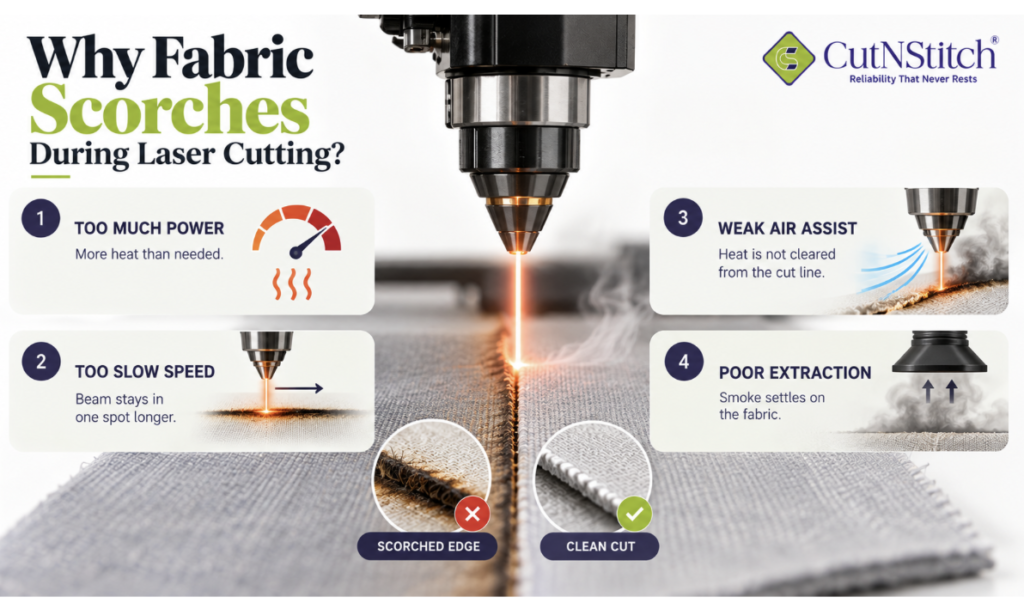
Fabric scorches because the laser puts more heat into the material than the cut needs. That extra heat spreads sideways from the cut line, browns natural fibres and leaves smoke residue on the surface. Too much power, too slow a speed, weak air assist or poor extraction all cause it, and usually more than one at once.
Heat that doesn’t leave
The beam only needs to vaporise a narrow line. Anything beyond that spreads into the fabric around it. Slow speed and high power keep the beam in one spot too long, so the edge cooks instead of cutting cleanly.
Smoke that settles back
Cutting releases smoke and tiny particles. If extraction is weak, that smoke settles on the fabric next to the cut and leaves a yellow or grey stain, especially on light colours.
Which fabrics cut cleanly, and which scorch easily?
Synthetic fabrics like polyester, nylon and acrylic blends cut most cleanly, because they melt and seal rather than burn. Natural fabrics like cotton, linen, silk and wool scorch more easily, because they char under heat. Light colours show marks the most, while dark fabrics hide minor browning.
| Fabric | Edge behaviour on a laser | Scorch risk |
| Polyester, nylon | Melts and seals | Low |
| Acrylic and synthetic blends | Seals, may harden slightly | Low |
| Cotton, linen | Browns at the edge | Medium to high |
| Silk | Browns easily, fine weave | Medium |
| Wool | Chars and smells | High |
| Coated or laminated fabric | Depends on coating | Test first |
Why synthetics behave better
The sealed edge on polyester isn’t a burn. It’s a melt, and it stops fraying. That’s why sportswear, flags, filters and technical textiles are where laser cutting earns its keep.
Natural fabrics need more care
Cotton and silk can still be laser cut with good results, but the margin for error is smaller. Settings that work on polyester will scorch cotton.
Which settings stop scorch marks on fabric?
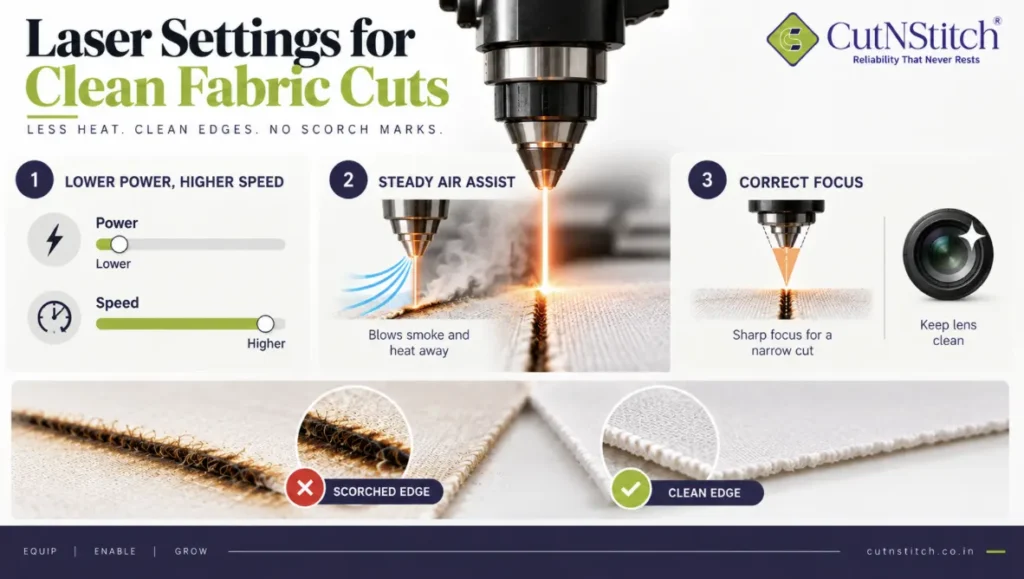
Lower power, higher speed and steady air assist stop most scorch marks on fabric. Research on CO2 laser cutting of cotton, silk, chiffon, jersey and satin found that 100 W power with 600 mm/s speed gave the best results on a single layer, while multi-layer cutting needed more power and moderate speed. The idea is to cut through in one quick pass, so heat doesn’t linger.
Power and speed first
Start with low power and high speed, then raise power only until the cut goes cleanly through. If you see browning, go faster before you go weaker. Too little power leaves uncut threads, which causes more handling and more marks.
Air assist and gas pressure
Air assist blows smoke and heat away from the cut. A study on pat silk found that cuts at 100 W, 7000 mm/min with 4 to 5 bar assist gas showed no fraying and less blackening. So what this means is that gas pressure is as important as power on delicate fabric, and it’s often the setting people forget to adjust.
Focus and lens care
A sharp focus gives a narrow, clean cut. A dirty lens or wrong focus spreads the beam, which puts more heat into a wider area. Clean the lens regularly, especially on smoky fabrics.
If your current machine keeps scorching despite these tweaks, it’s worth sending a sample before adjusting further. Sometimes the fix is a bed or extraction change, not a setting.
What setup changes help besides settings?
Besides power and speed, factories reduce scorch marks with the right bed, strong extraction, a flat fabric surface and masking on sensitive fabrics. These setup steps stop smoke, reflections and uneven focus from marking the edge.
Bed choice
A honeycomb bed lets smoke escape from underneath, but the metal can reflect heat back into the fabric. A blade or slat bed reduces contact and back reflection. For long fabric rolls, a conveyor bed with auto feeding keeps fabric flat and moving.
Extraction
- Downdraft from below: Pulls smoke through the bed, away from the fabric surface.
- Side blow at the cut: Pushes residue away before it settles.
- Clean ducts: Blocked ducts are a common cause of sudden staining.
Keeping fabric flat
Wrinkles change the focus distance, so parts of the cut get more heat than others. Vacuum hold-down or careful spreading keeps the whole sheet at the right height. When the CutNStitch team runs a fabric trial, flatness is the first thing checked, before any power or speed is touched.
Can the same laser also cut stainless steel?
No. A CO2 laser built for fabric is not a laser cutting machine for stainless steel. Its wavelength reflects off metal, so cutting stainless needs a fibre laser, which is a different type of machine. If you cut both fabric and metal, you’ll need two machines, one for each.
Why this matters when buying
Some buyers search for one machine to do everything. A fabric laser optimised for clean edges uses moderate power, fine focus and fume handling for textiles. A metal laser uses a different source, different optics and assist gases like oxygen or nitrogen at much higher pressure. Mixing the two jobs on one machine doesn’t work well.
Frequently asked questions
Can a laser cut cotton fabric without burning?
Mostly yes, with the right settings. Use low power, high speed and strong air assist, and test on scrap first. Expect a slight browning on very light cotton, which is often acceptable once seamed.
Does laser cutting seal fabric edges?
Yes, on synthetic fabrics. Polyester and nylon melt slightly at the cut, which seals the edge and stops fraying. Natural fabrics don’t seal this way, so they may still fray if left unfinished.
Why do my laser-cut edges look yellow?
Yellow edges usually come from smoke settling back onto the fabric or from too much heat. Improve extraction, raise speed, check air assist pressure and clean the lens before lowering power further.
What power laser is best for cutting fabric?
Single layers of most fabrics cut well at around 100 W with high speed. Thicker or multi-layer fabric needs more power and slower speed. The right number depends on the fabric, so always test first.
Can a fabric laser also cut stainless steel?
No. A CO2 laser for fabric isn’t built for metal, which reflects its beam. Stainless steel needs a fibre laser with different optics and assist gases, so it’s a separate machine.
Fabric laser cutting with cleaner edges
CutNStitch supplies CO2 laser machines for apparel, outdoor and technical textile makers, with setups chosen around the fabric rather than a standard spec sheet. The group behind it, Stamp’IT Robotai and Solutions, is ISO 9001:2015 certified and has installed over 10,000 machines across 40 countries. The flatbed cutting plotter gives fabric a large, even working area, and keeping the material flat at the right focus height is half the battle against scorch marks for apparel manufacturers running long shifts.
Clean edges come from matching the machine and settings to your fabric, then testing before you cut a full lay. Talk to an expert, send a fabric sample, and see a test cut before you decide.