
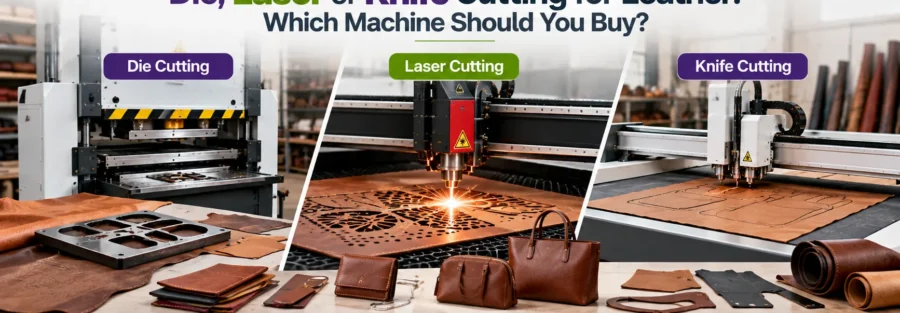
For high-volume repeat shapes like shoe soles, insoles and small leather goods, die cutting is fastest. For short runs, custom designs and expensive hides, a CNC knife cutter is the safest all-rounder, because it cuts any shape with a clean natural edge and no dies to buy. A laser is best kept for thin leather, engraving and perforation work. If you’re comparing a laser cutting machine in India for leather, check first whether a knife cutter fits your work better.
Most leather workshops start with a clicker press and a rack of steel dies. It works. It’s fast. But every new design means a new die, and every hide still gets cut by eye.
As orders get smaller and more varied, that model starts to creak. That’s when owners start looking at lasers and CNC knife cutters, and the choice isn’t obvious. This guide compares all three methods for leather, with the trade-offs that matter on a real cutting floor.
How do die, laser and knife cutting work on leather?
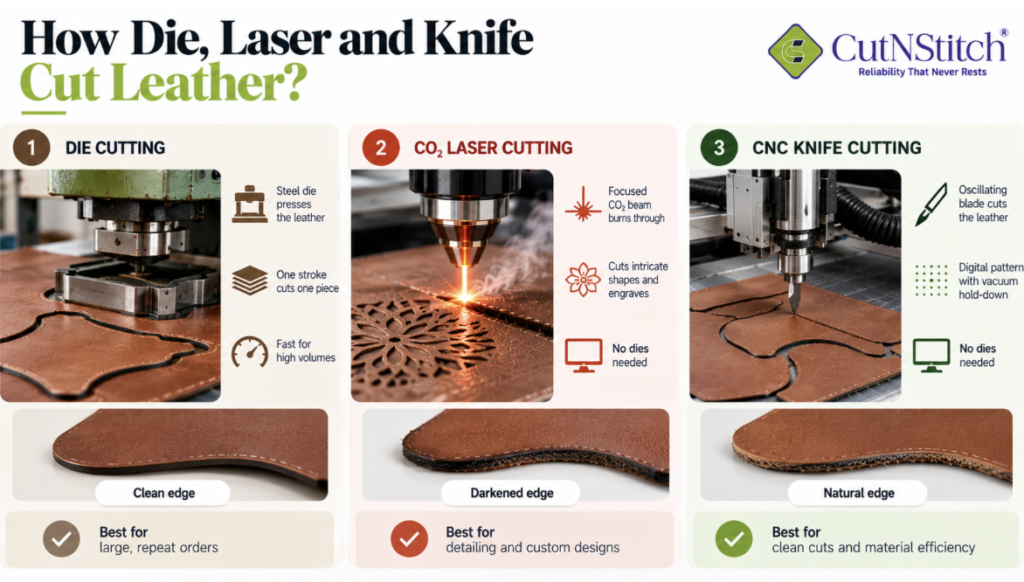
Die cutting presses a shaped steel blade through leather using a clicker or hydraulic press. Laser cutting burns a path through the leather with a focused CO2 beam. CNC knife cutting follows a digital pattern with an oscillating blade while vacuum holds the hide flat. Each method changes how fast you cut, how you handle design changes and what the edge looks like.
Die cutting
An operator places the die on the hide and presses. One stroke cuts one piece. It’s the fastest method per piece once dies exist, but each design and size needs its own die.
Laser cutting
The laser follows a digital file, so no dies are needed. It cuts intricate shapes and engraves in the same pass, but the heat darkens the edge.
CNC knife cutting
The knife also follows a digital file, with no dies. It cuts cold, so the edge stays natural, and software can nest pieces around defects on the hide.
How do the three methods compare side by side?
Die cutting wins on speed for repeat shapes, laser wins on detail and decoration, and knife cutting wins on flexibility and edge quality. The right pick depends on how often your designs change, how expensive your leather is, and whether the edge shows in the finished product.
| Factor | Die cutting | CO2 laser | CNC knife |
| Speed on repeat shapes | Very fast | Moderate | Moderate to fast |
| Cost per new design | New die each time | Just a file | Just a file |
| Edge finish | Clean, natural | Darkened, charred | Clean, natural |
| Fine detail | Limited by die | Excellent | Very good |
| Engraving and perforation | No | Yes | Limited |
| Nesting around hide defects | Manual | Software | Software |
| Multi-layer cutting | Possible | Limited | Possible on thin leather |
| Fumes | None | Needs extraction | None |
When does die cutting still make sense?
Die cutting makes sense when you cut the same shapes in large volumes for months at a time, like insoles, shoe components, wallet parts and belt tips. Once the die is paid for, nothing beats a press for speed per piece. It stops making sense when designs change every season or sizes multiply.
Where dies shine
- Fixed product lines: A belt maker cutting the same keeper and tip shapes all year.
- Footwear components: Insoles and linings cut in thousands.
- Low-skill operation: A press is simple to run and maintain.
Where dies cost you
- Die cost per design: Each new style and size adds a die, and they pile up.
- Hide waste: Operators place dies by eye, so nesting is only as good as the person cutting.
- Slow changeovers: Short runs spend more time swapping dies than cutting.
When is a laser the right choice for leather?
A laser is the right choice when your leather work depends on detail: engraving logos, perforating patterns, cutting very fine shapes or thin decorative pieces. It’s also a good starter machine for small workshops, since a compact laser cutting machine small enough for a corner bench can cut and brand in one step.
The edge problem
Leather burns rather than melts, so a laser leaves a dark, carbonised edge. A study using 1 mm sheep leather found that a diode laser produced a smaller heat affected zone than a CO2 laser, and pointed to excess heat as the cause of carbonisation. So what this means is that the edge darkening on CO2-cut leather is built into the process, and you manage it with settings and edge finishing rather than removing it.
Where the laser pays back
- Personalised goods: Names, logos and patterns engraved on wallets, diaries and bags.
- Perforated panels: Shoe uppers and car seat leather with hole patterns.
- Sampling: Quick prototypes without ordering a die.
If you sell products where a dark edge is acceptable or gets painted anyway, a laser can handle both cutting and branding.
Why are many leather units moving to CNC knife cutting?
Many leather units move to CNC knife cutting because it combines the no-die flexibility of a laser with the clean edge of a die, and adds software nesting that gets more pieces from each hide. When leather is your biggest cost, better hide yield often pays for the machine faster than labour savings do.
Yield is the real saving
Leather hides are irregular and carry scars, holes and thin patches. Software nesting places pieces around these defects. One factory using computerised nesting reported as much as a 10% improvement in leather yield, and on expensive hides even a few points of yield adds up quickly.
Other gains
- No die inventory: New designs go from file to cut the same day.
- Consistent pieces: Every piece matches the pattern, regardless of operator.
- Clean edges: No charring, no smell, no edge painting just to hide burn marks.
If you’re unsure whether yield or speed matters more for your unit, a quick look at your monthly hide spend usually settles it. That’s usually where a CutNStitch trial starts too: one real hide, cut once by hand and once on the machine, with the pieces counted.
Frequently asked questions
Which is the best leather cutting machine for a small workshop?
It depends on your products. A small laser suits engraving and fine detail, a CNC knife suits mixed designs with clean edges, and a clicker press suits fixed repeat shapes. Many small units start with one and add another later.
Does laser cutting damage leather?
It darkens the edge. Leather burns rather than melts, so laser-cut edges show a carbonised line and give off smoke. Many products accept this or paint the edge, but premium goods usually prefer a knife.
Is a CNC knife cutter faster than die cutting?
Not on long runs of one shape, where a press is faster per piece. On short runs and frequent design changes, a knife is faster overall because there’s no die making or changeover time.
Can a CNC knife cutter reduce leather wastage?
Yes. Nesting software places pieces around hide defects and fits them closer than manual die placement, which can improve yield. On costly leather, that saving often matters more than speed.
Do I need dies for a laser or knife cutter?
No. Both machines cut directly from digital pattern files, so new designs need only a file change. That makes them far more flexible than die cutting for short runs and custom work.
Leather cutting matched to how you work
CutNStitch supplies both CNC digital knife cutting plotters and CO2 laser machines for leather goods, footwear and upholstery makers, backed by Stamp’IT Robotai and Solutions, an ISO 9001:2015 certified Thane group with 10,000+ machines installed worldwide. The fixed platform model knife cutter handles hides and mixed shapes with a clean edge, while CO2 machines cover engraving and perforation for leather industry brands that sell on detail.
The right leather cutter depends on your designs, your hides and your edges, not on which technology sounds newest. Talk to an expert, send a sample hide and your top five products, and get a machine recommendation built around them.