
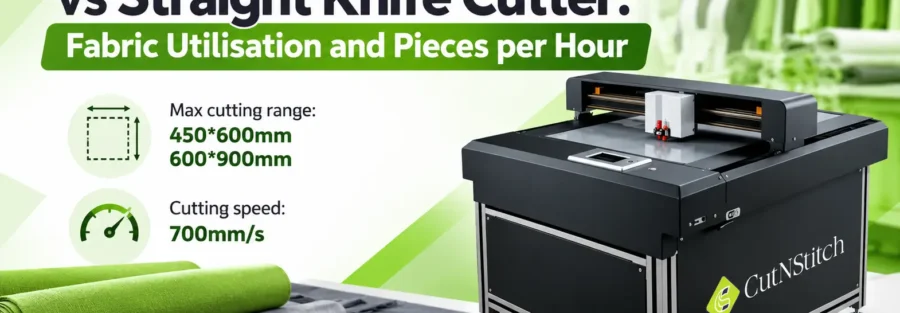
A flatbed plotter holds material flat on a vacuum bed and cuts it with a computer-guided head, while a straight knife is carried through a lay by an operator. The plotter wins on repeat accuracy, nesting and fabric utilisation. The straight knife still wins on deep lays of simple, unchanging shapes. Most Indian factories need both, used for different work.
This comparison gets argued badly because people compare the wrong number. Someone quotes pieces per hour from a brochure, someone else quotes the price of a straight knife, and the actual difference between the two machines never gets discussed.
The actual difference is what happens to your fabric and what happens to the panels after they leave the cutting table.
Which machine cuts more pieces per hour?
On a deep lay of one simple shape, a straight knife cuts more pieces per hour than a flatbed plotter, because it cuts 100 plies in a single pass while the plotter is usually working through a much shallower stack. On mixed styles with curves and notches, the plotter finishes first, because it never stops to re-mark, re-check or recut.
That’s the whole comparison in two sentences, and it is why the honest answer depends on your order book.
A factory cutting 20,000 pieces of the same basic tee is in straight knife territory. A factory cutting forty styles in a season, with sampling running alongside bulk, is losing time to manual cutting whether or not the pieces-per-hour figure says so.
Indian textile and apparel exports, including handicrafts, grew from Rs. 2,33,304 crore in 2020-21 to Rs. 3,19,573.2 crore in 2024-25, a CAGR of 8.2 per cent. Growth like that arrives as more styles and shorter runs, not as bigger runs of the same garment. That shift is what pushes cutting rooms towards computerised cutting.
How much fabric does each method actually use?
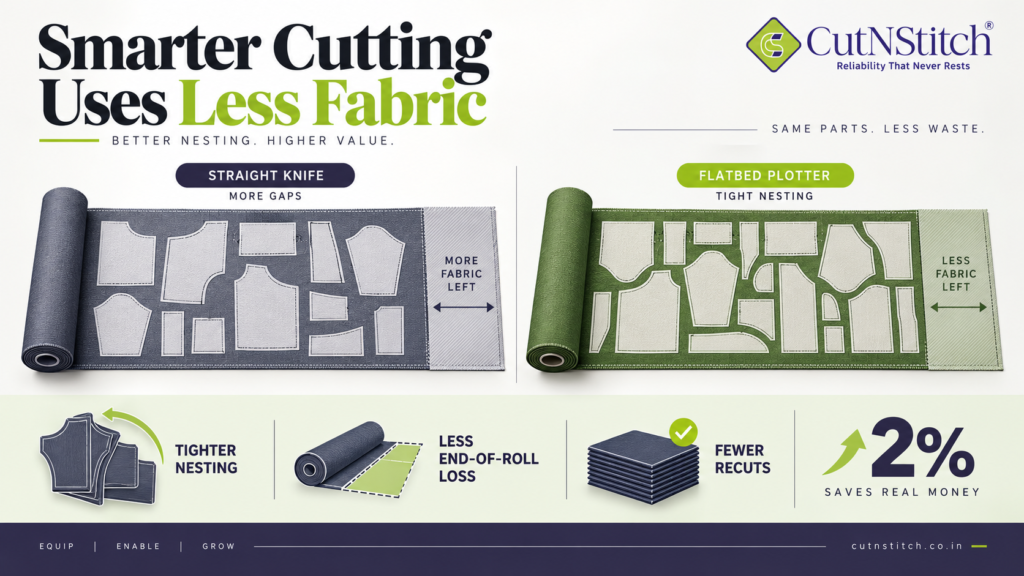
A flatbed plotter improves fabric utilisation because nesting is done in software, so panels are placed closer together than an operator can manage on a table by eye. A straight knife is limited by the marker it is given and by the space an operator needs to steer the blade safely around each shape.
The gain shows up in three places.
- Tighter nesting, since the software can rotate and interlock shapes without worrying about blade access
- Less end-of-roll loss, because remnants can be nested with a fresh set of small parts
- Fewer recuts, and a recut panel costs you the fabric twice
Two per cent of a fabric bill is not a rounding error in this industry. It is often the difference between a profitable order and a break-even one.
What does each machine demand from your operators?
A straight knife is only as accurate as the person holding it, so accuracy walks out with the operator. A flatbed plotter moves the skill requirement from the blade to the file, which is a very different hiring problem and, in most clusters right now, a considerably easier one to solve.
This matters more every year. Under the SAMARTH scheme, about 5.41 lakh persons have been skilled, of which nearly 4.76 lakh, or 88 per cent, are women, and that pipeline still does not keep pace with attrition in most clusters.
An experienced straight knife operator who leaves takes accuracy with them. A plotter keeps cutting the same way for whoever’s on shift.
Flatbed plotter or straight knife: which should you buy first?
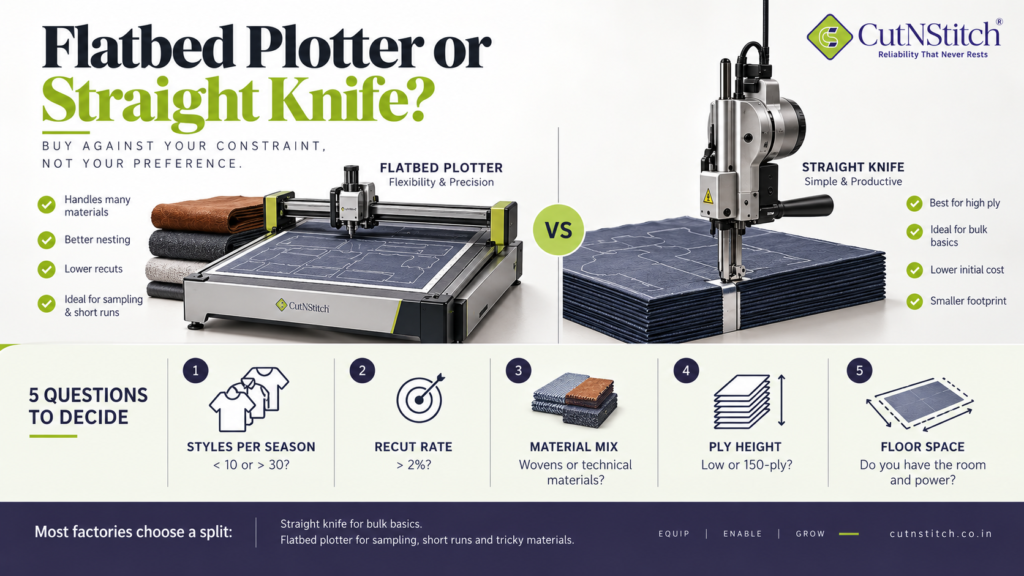
Buy against your constraint, not against the machine you admire. Count your styles per season, check your recut rate, look at your material mix, measure your real ply height and price the floor space you’d need. Those five answers usually point clearly at one machine or at a split between both.
- Count your styles per season. Under ten, a straight knife plus a good marker is defensible. Over thirty, manual cutting is quietly costing you fabric and time.
- Check your recut rate. If more than two per cent of panels are recut, the problem is cut accuracy and a plotter fixes it directly.
- Look at your material mix. If you are moving into leather, foam, gasket sheet or technical materials, a knife plotter handles them with a tool change.
- Measure your real ply height. If you genuinely run 150-ply lays of one shape all year, the straight knife is still the right machine.
- Price the floor space. A plotter needs a fixed footprint and a clean power supply, which is a real constraint in older units.
Most factories land on a split. Straight knives keep cutting bulk basics, and a CutNStitch flatbed cutting plotter takes the sampling, the short runs, the leather and anything with a tolerance a buyer will inspect.
If you want a quick read on which side your work falls, a month of cutting and recut data is usually enough to settle it.
What does a flatbed plotter cost you to run?
Running costs are modest but not zero, and they’re different in kind from a straight knife. A plotter consumes blades, cutting mat or felt, vacuum filters and continuous pump power. A straight knife consumes blades and sharpening time. The bigger difference is who repairs each one when it stops.
| Cost item | Flatbed plotter | Straight knife |
| Blades and tools | Blade replacement by material and hours | Frequent sharpening, regular blade change |
| Power | Continuous draw from the vacuum pump | Low |
| Consumables | Cutting mat or felt, vacuum filters | Minimal |
| Skill | File preparation and nesting | Blade handling, sharpening, judgement |
| Downtime risk | Needs an engineer for control faults | Repairable in most local workshops |
The vacuum pump is the item people underestimate. It runs whenever the machine runs, and undersizing it is the most common reason a plotter underperforms on light knits.
Frequently asked questions
Is a flatbed cutting plotter faster than a straight knife?
Not always. A straight knife cuts more pieces per hour on deep lays of one simple shape. A plotter is faster overall on mixed styles, curved panels and short runs, because it removes re-marking, checking and recutting from the cycle.
How many plies can a flatbed plotter cut?
Most knife plotters work best on low to medium ply heights, typically single ply up to a few centimetres of compressed material, depending on the tool and the vacuum. Deep 150-ply lays remain straight knife work in most factories.
Does a flatbed plotter work on leather?
Yes. An oscillating knife cuts leather cleanly and lets you nest around hide defects, which is exactly where manual cutting loses material. Laser is unsuitable for leather because the heat scorches and discolours the edge.
What fabric utilisation improvement can I expect?
Improvements come from tighter software nesting and fewer recuts rather than from a single fixed figure. Measure your current utilisation over a full month first, then compare, because seasonal style mix affects the number more than the machine does.
Do I still need a straight knife if I buy a plotter?
Usually yes. Most Indian factories run both machines. Straight knives handle deep lays of basic styles, while the plotter takes sampling, short runs, leather, technical materials and any panel carrying a tolerance a buyer will inspect.
Cutting machines built around Indian production realities
CutNStitch supplies CNC knife plotters, CO2 laser cutters and automated stitching machines as a brand of Stamp’IT Robotai & Solutions, an ISO 9001:2015 certified manufacturer in Thane with over 50 years of group engineering experience. The group has installed more than 10,000 machines across 40 countries, and the service network behind that number is what keeps a cutting room running when something fails mid-order.
The cutting range also serves the advertising sector, where the same nesting and tolerance questions apply to very different materials, and extends into CO2 laser machines for work that suits a beam rather than a blade.
The right answer here is rarely one machine replacing another. It is knowing which work belongs on which table. Talk to an expert about your style mix, ply height and material list, and get a straight recommendation.