
A fabric cutting machine cuts garment panels from a spread of fabric, either with a moving blade guided by an operator or with a computer-controlled head that follows a digital marker. Indian factories use five main types: straight knife, band knife, round knife, CNC oscillating knife, and CO2 laser. The right one depends on ply height, material behaviour and how often your patterns change.
Walk into any cutting room in Noida, Tiruppur or Ludhiana and you will see the same argument playing out. One table has a straight knife that has been running for fifteen years. Two tables away, someone is asking whether a computerised machine would pay for itself before the next season.
Both people are right about something. The straight knife is cheap, forgiving and understood by everyone on the floor. It’s also the reason the same style comes back with different measurements from different bundles.
India’s textile and apparel sector employs over 45 million people, so the labour argument is never abstract here. It’s the specific question of whether the four people on your cutting table are producing panels a supervisor has to check twice.
What does a fabric cutting machine actually do in a cutting room?
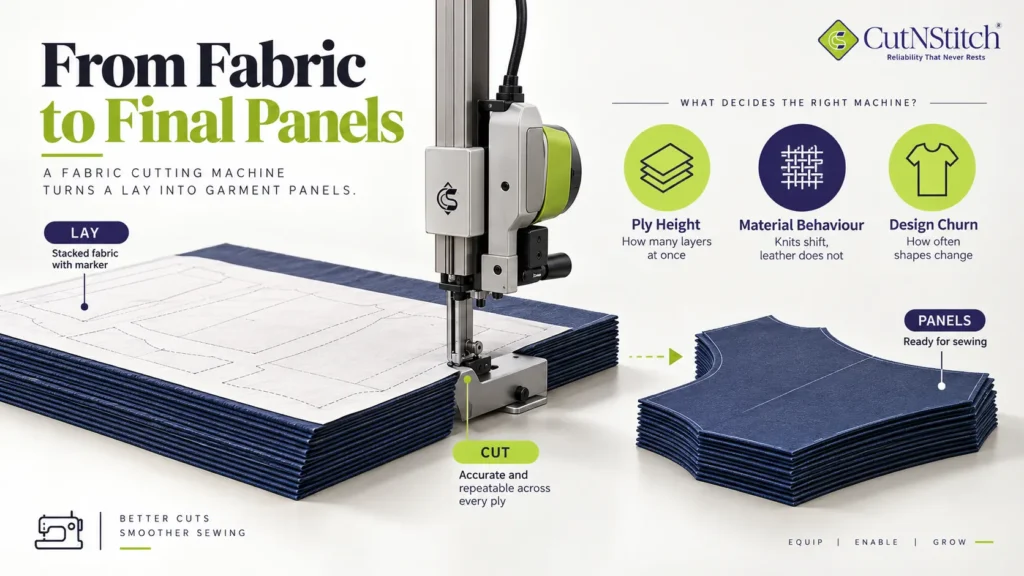
A fabric cutting machine separates garment panels from a lay, which is a stack of fabric plies laid out flat with a marker printed or projected on top. Its job is accuracy and repeatability across every ply in that stack, not raw speed. A cut panel that drifts by two millimetres becomes a sewing problem later.
That’s the part most buying decisions miss. Cutting is measured in the sewing room, not at the cutting table.
Three things decide whether a machine suits you. Ply height, which is how many layers you cut at once. Material behaviour, since knits shift and leather does not. And design churn, meaning how often the shapes you cut change.
What are the main types of fabric cutting machines used in India?
Five machine types cover almost every Indian factory: straight knife, band knife, round knife, CNC oscillating knife and CO2 laser. Each trades speed against accuracy in a different way, and each suits a different combination of ply height, material and style churn. Here’s how they compare on the floor.
| Machine type | Best suited to | Typical ply height | Weakness |
| Straight knife | High-volume basic styles, thick lays | 50 to 200 plies | Accuracy depends entirely on the operator |
| Band knife | Small precise parts, collars, cuffs | Bundle-level | Operator carries fabric to the blade |
| Round knife | Single ply, sampling, light lays | 1 to 20 plies | Poor on tight curves |
| CNC oscillating knife | Repeat accuracy, complex shapes, varied materials | Low to medium | Higher capital cost |
| CO2 laser | Synthetics, sealed edges, engraved detail | Single ply mostly | Not suitable for natural fibres that scorch |
Straight knife and band knife
The straight knife is the workhorse. It handles a deep lay and it is the cheapest way to cut volume. The catch is that the blade leans. On a tight curve, the top ply and the bottom ply come out as slightly different shapes, and nobody notices until sewing.
A band knife inverts the relationship. The blade stays still and the operator moves the bundle into it, which is why band knives are used for small components where precision matters more than throughput.
Round knife and CNC oscillating knife
Round knives suit sampling and short lays of light material. They are quick on straight runs and awkward on curves.
A CNC oscillating knife cuts to a file, not to a pencil line. The same panel comes out the same way on Monday morning and Friday evening. The CutNStitch fixed platform cutting plotter is built for exactly this kind of work, where shapes change often and the tolerance does not.
Which cutting method suits which material?
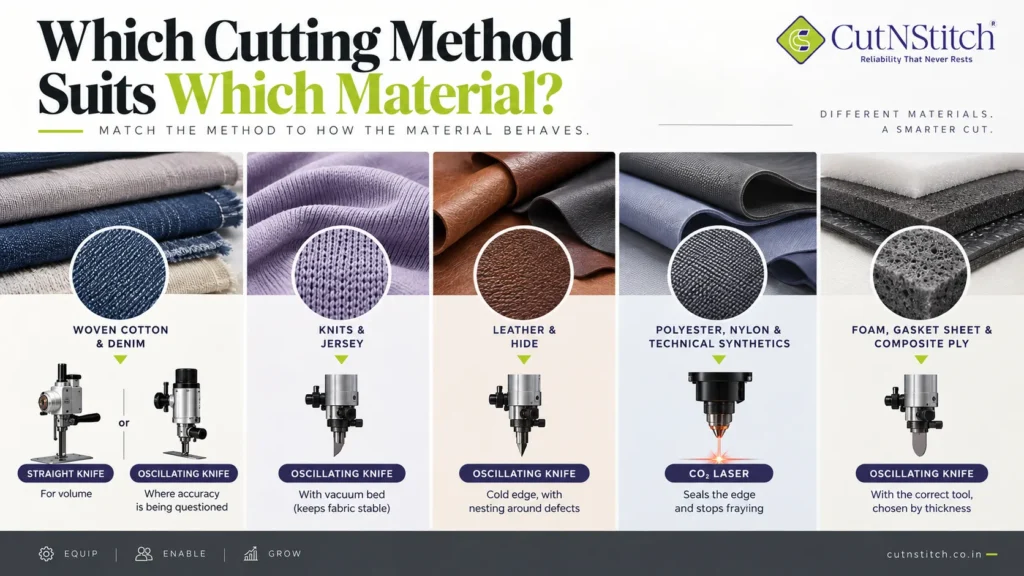
Match the method to how the material behaves under a blade or a beam, not to the fabric name on the purchase order. Wovens tolerate almost anything, knits need vacuum hold-down, leather needs a cold edge and nesting around defects, and synthetics benefit from the sealed edge a laser leaves behind.
- Woven cotton and denim: straight knife for volume, oscillating knife where accuracy is being questioned
- Knits and jersey: oscillating knife with a vacuum bed, because the fabric moves if it is not held down
- Leather and hide: oscillating knife, since laser scorches and hides need nesting around defects
- Polyester, nylon and technical synthetics: CO2 laser, which seals the edge as it cuts and stops fraying
- Foam, gasket sheet and composite ply: oscillating knife with the correct tool, chosen by thickness
The mistake we see most often is buying for the fabric a factory runs today rather than the one a buyer will ask for next year.
How do you decide between a manual cutter and a CNC machine?
Work the maths on material, not on labour. Fabric is the single biggest cost driver in a garment, at 50 to 80 per cent of garment cost. At that share, a two per cent gain in fabric utilisation is usually worth more than the operator you were hoping to redeploy.
Run these four numbers before you commit.
- Your current fabric utilisation percentage, measured over a full month rather than a good week
- Rejection and recut rate traced back to cutting, not to sewing
- Pieces per hour at your real ply height, not the brochure figure
- How many different styles you cut in a season, since churn is where computerised cutting earns its keep
If your styles rarely change and your lays are deep, a straight knife is still a sensible machine. If you are cutting forty styles a season with tight tolerances, manual cutting is quietly costing you fabric every single day.
Not sure which side of that line you sit on? Send across a month of cutting data and it usually answers itself.
Frequently asked questions
Which fabric cutting machine is best for a small garment unit?
A round knife or a compact CNC knife plotter suits small units best. Round knives cost less and handle light lays. A knife plotter costs more but removes operator dependency and improves fabric utilisation on varied styles.
Can one machine cut both fabric and leather?
Yes. A CNC oscillating knife cuts woven fabric, knits and leather by changing the tool and the settings. Laser machines cannot, because leather and natural fibres scorch and discolour rather than cutting cleanly.
How many plies can a straight knife cut at once?
A straight knife typically cuts 50 to 200 plies depending on blade length, fabric thickness and machine power. Accuracy drops as the lay gets deeper, since the blade leans slightly through the stack on curved sections.
Does a computerised cutting machine reduce fabric waste?
Yes. Nesting happens in software rather than by eye, so panels sit closer together and marker efficiency improves. The saving compounds across every lay, which is why fabric cost usually justifies the machine before labour does.
What maintenance does a fabric cutting machine need?
Blade sharpening or replacement, vacuum filter cleaning, belt and rail checks, and lubrication on moving parts. Skipping blade maintenance is the fastest way to lose cut quality, since a dull blade drags fabric instead of cutting it.
Machines built for Indian cutting rooms
CutNStitch builds industrial cutting and stitching machines as a brand of Stamp’IT Robotai & Solutions, an ISO 9001:2015 certified manufacturer based in Thane with more than 50 years of group engineering behind it. The group has installed over 10,000 machines and supports customers across 40 countries, which matters most when a machine goes down mid-order and you need an engineer, not a call centre.
The range covers oscillating knife plotters, CO2 laser cutters and automated stitching units, supplied to the apparel sector and beyond, with the CNC digital knife cutting plotter range built specifically around varied materials and changing patterns.
Every cutting room is a different set of constraints, so the useful conversation is about your material, your ply height and your style churn rather than a spec sheet. Check the full product range and talk to an engineer about what your floor actually runs.