

A CO2 laser cuts by burning through material with a focused beam, which seals the edge of synthetics and scorches natural fibres. An oscillating knife cuts mechanically with a blade, leaving a cold edge on any material including leather, foam and composite ply. The material on your table decides which one you need, not the machine’s speed rating.
Most laser versus knife arguments are settled by whoever has the better sales deck. That’s a bad way to spend capital, because these two machines are not competing versions of the same tool. They remove material in fundamentally different ways.
One applies heat. The other applies a blade. Everything else follows from that.
What actually happens to the material in each process?
A laser melts and vaporises material along the cut line, leaving a narrow band of heat-affected material either side. A knife severs fibres mechanically with no heat input, so the edge stays exactly as the material was.
That heat band is not a rounding error. One study of CO2 laser cutting of fibre reinforced composites measured a minimum heat affected zone of 162 micrometres on 2 mm material and 382 micrometres on 4 mm material. Assist gas pressure alone accounted for more than 70 per cent of the variation at the thinner gauge.
On polyester webbing, that heat band is a feature, since it seals the edge and stops fraying. On a cotton twill or a leather panel, the same heat band is scorching and discolouration you cannot remove.
Which materials suit a CO2 laser?
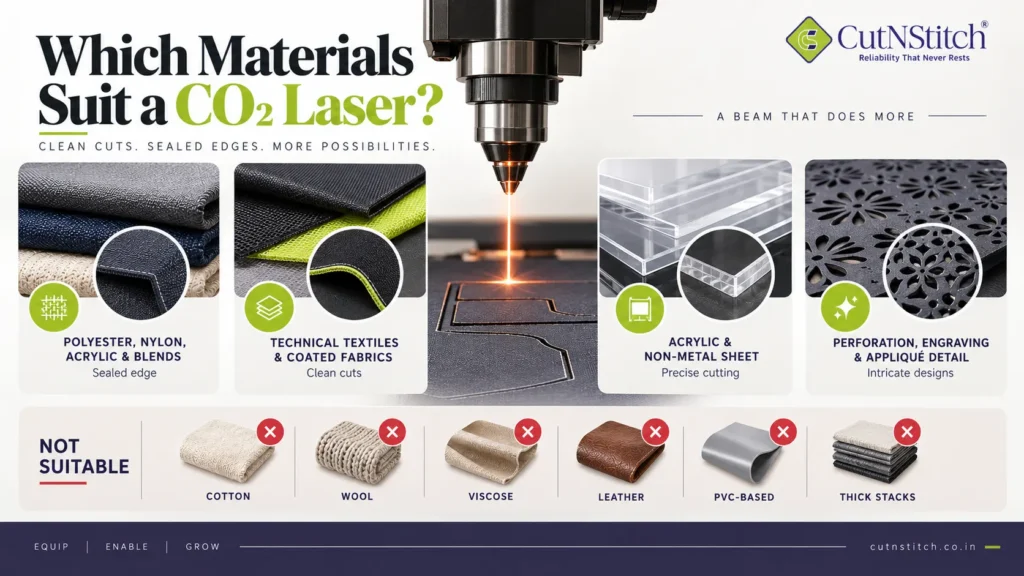
CO2 lasers suit synthetic and man-made materials that melt cleanly, plus non-metal sheet where engraved or perforated detail is part of the design. Polyester, nylon, acrylic and coated technical fabrics all cut with a sealed edge, which removes a finishing operation. Natural fibres and leather don’t belong anywhere near a laser bed.
- Polyester, nylon, acrylic and blends: the edge seals as it cuts, so no overlocking is needed on raw edges
- Technical textiles and coated fabrics: clean cuts around complex profiles with no tool pressure
- Signage acrylics and non-metal sheet: a parametric study of CO2 laser cutting of acrylic found scanning speed, current and the nozzle to workpiece gap to be the variables that govern edge quality
- Perforation, engraving and appliqué detail: work a blade physically cannot do
Where lasers fail is predictable. Cotton, wool, viscose and leather scorch. Thick stacks are impractical, since the beam loses focus with depth.
Anything PVC-based releases fumes you should not be cutting without proper extraction, which is a facility question rather than a machine one.
Which materials suit an oscillating knife?
An oscillating knife suits anything that must keep a cold, unaltered edge, and anything that arrives in thickness rather than in thin sheets. Leather, foam, gasket material, composite ply, woven and knitted fabric all cut mechanically with no heat input, so the material either side of the cut line is unchanged.
The list is broader than most buyers expect. Leather and hide, where nesting around defects matters. Foam and gasket sheet, where thickness is the whole point.
Composite plies and prepreg sit here too, along with woven and knitted fabric held down by vacuum, and cardboard packaging prototypes cut with creasing tools rather than blades.
Edge quality here depends on tool choice and cutting parameters rather than heat. Cutting speed, feed rate and depth of cut govern how clean the edge comes out, which is the mechanical equivalent of the same lesson. The settings matter more than the machine’s headline specification.
How do you choose between them for your own floor?
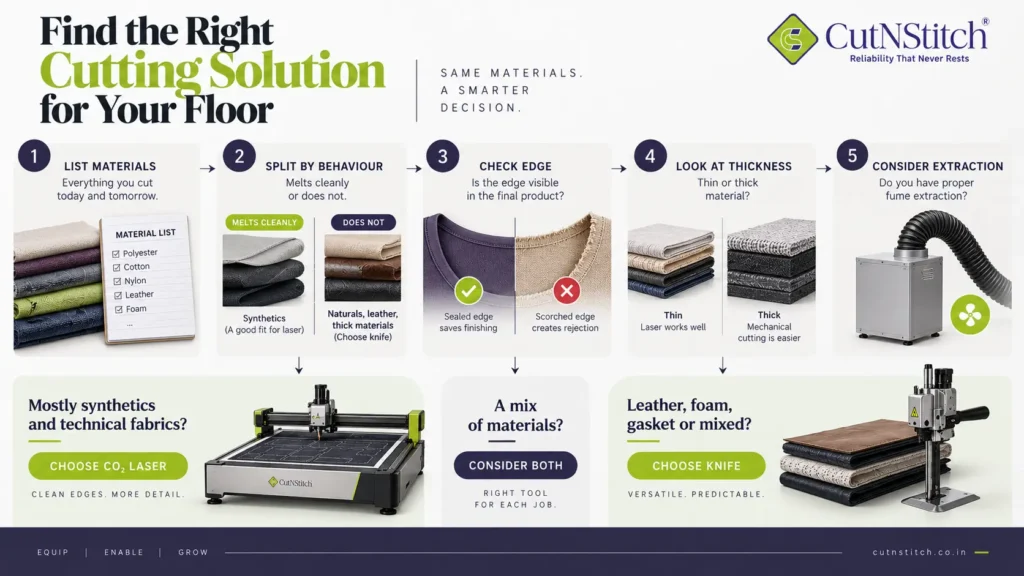
Choose by material behaviour rather than by machine specification. List everything you cut, split it into what melts cleanly and what doesn’t, check where the edge is visible in the finished product, then look at thickness and extraction. Work through your material list in this order and it usually decides for you.
- List every material you cut today and expect to cut next year. Not the main one, all of them.
- Split that list into melts cleanly and does not. Synthetics on one side, naturals, leather and thick technical material on the other.
- Check where the edge is visible in the finished product. A sealed synthetic edge saves a finishing operation. A scorched cotton edge creates a rejection.
- Look at thickness. Beyond a few millimetres of dense material, mechanical cutting is more predictable than a beam.
- Add the extraction question. Laser cutting needs proper fume extraction, which is a facility decision as much as a machine decision.
Factories running mostly polyester and technical fabrics buy a laser. Factories running leather, foam, gasket or mixed materials buy a knife. Factories doing both buy both and stop pretending one machine covers everything.
If your material list genuinely straddles the line, send it across and it can be sorted line by line rather than in general terms.
What do the two machines cost you to keep running?
Running costs differ in kind, not just in size. A laser consumes a tube with a finite service life, optics that need cleaning and replacing, assist gas, a chiller and fume extraction. A knife machine consumes blades, cutting mats and vacuum pump power. Neither is expensive, but they’re budgeted differently.
| Item | CO2 laser | Oscillating knife |
| Main consumable | Laser tube with a finite service life | Blades and cutting tools |
| Optics | Lens and mirror cleaning and replacement | Not applicable |
| Utilities | Chiller, assist gas, extraction | Vacuum pump |
| Bed | Honeycomb or slat bed maintenance | Cutting mat or felt replacement |
| Safety | Fume extraction, enclosure, interlocks | Blade guarding |
The laser tube is the item that catches people out. It’s a wear part with a service life, not a permanent fitting, and it should sit in your costing from day one.
Frequently asked questions
Can a CO2 laser cut cotton and leather?
It can cut them, but not acceptably for most products. Cotton, wool and leather scorch and discolour at the cut edge because they burn rather than melt. Use an oscillating knife for natural fibres and leather.
Does a laser cutter seal fabric edges?
Yes, on synthetics. Polyester, nylon and similar man-made fibres melt at the cut line and fuse, which prevents fraying and often removes the need for a separate edge finishing operation on straps, panels and technical textiles.
Which machine is better for composite materials?
An oscillating knife is safer for composite plies, since laser heat can damage the resin system. Knife cutting quality depends on tool choice, cutting speed and depth of cut, which are controllable settings on any decent machine.
Can one machine cut both fabric and rigid sheet?
An oscillating knife with interchangeable tools comes closest, handling textile, foam, gasket and board with a tool change. A laser handles synthetics and non-metal sheet but not thick or natural material.
How much thickness can each method handle?
Lasers are practical on thin material and lose focus with depth. Knife machines cut thickness limited by blade length and material density, which is why foam, gasket sheet and multi-millimetre technical materials are knife work.
Cutting technology chosen around your material list
CutNStitch manufactures both CO2 laser machines and CNC oscillating knife plotters as a brand of Stamp’IT Robotai & Solutions, an ISO 9001:2015 certified company in Thane backed by more than 50 years of group engineering. The group has installed over 10,000 machines across 40 countries and serves apparel, leather, advertising and technical material producers from the same engineering base.
The CutNStitch fixed workbench CO2 laser cutter and the knife plotter range are specified around material behaviour. That is why the automotive interior sector ends up with very different machines from apparel units, down to the laser cutting accessories supplied with them.
Bring your material list rather than a machine name, and the choice usually makes itself. Talk to an expert about what you cut, how thick it is, and where the edge shows.