

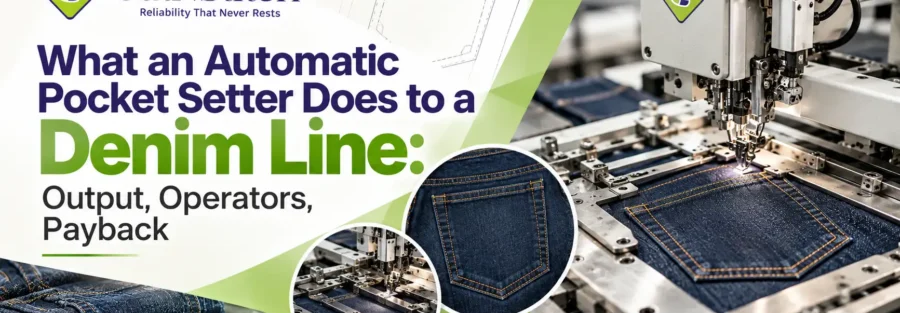
An automatic pocket setter positions, folds, presses and stitches a patch pocket in one cycle, replacing a sequence that normally takes a skilled operator several handling steps. On a denim line it changes three things: pieces per hour at the pocket operation, how many trained operators you need, and how consistently pocket placement matches across a bundle.
Pocket attach is the operation that decides whether a pair of jeans looks right. It is also the operation where an experienced operator and a new one produce visibly different work.
Every denim unit knows this. Very few have costed it.
What does an automatic pocket setter actually replace?
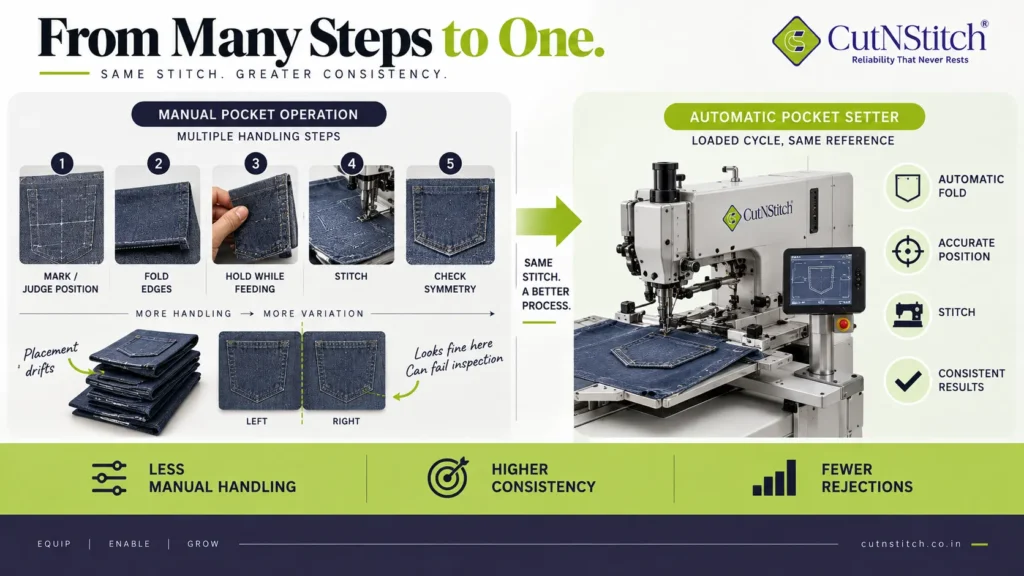
It replaces the handling, not the stitching. A manual pocket operation involves marking or judging position, folding the pocket edges, holding the fold while feeding the panel, stitching, then checking symmetry against the other side. An automatic setter collapses those steps into a loaded cycle where the machine handles fold, position and stitch to the same reference every time.
That is why the gain shows up as consistency before it shows up as speed.
Watch a manual pocket operation for an hour and you will see the same pattern. Output is fine. Placement drifts. The drift is small enough to pass at the table and large enough to catch a buyer’s inspector.
How does it change output on the line?
Output improves in two places, and only one of them is the pocket operation itself. Cycle time at the operation becomes predictable instead of operator-dependent, which makes line balancing easier. Downstream, pocket-related rework falls, and rework is where denim lines quietly lose hours that never get attributed back to pockets.
At the operation, cycle time becomes predictable rather than operator-dependent, so line balancing gets easier. Downstream, rework falls, and rework is where denim lines quietly lose hours.
Defects per hundred units, or DHU, is the metric to watch here. It counts defects found per 100 garments checked, and reducing it is the standard measure of quality improvement work in apparel production. Pocket placement and pocket stitching defects sit in that count, and every one of them is a garment that goes back down the line.
The honest framing is this. A pocket setter won’t double your output. It removes a variable that was costing you output in ways your production report never attributed to pockets.
What happens to your operator requirement?
You don’t stop needing people. You need fewer at that operation, and the skill demand shifts from stitching judgement to loading and machine handling. That’s a different hiring problem, and for most Indian denim units it’s an easier one, because a loading role can be trained in days rather than months.
For most denim units in India, that is the real attraction. Skilled operator attrition is the constraint that breaks planning, since an experienced pocket operator who leaves takes their consistency with them. A machine doesn’t.
Three practical effects follow.
- A newly trained operator can hold acceptable quality at the operation within days rather than weeks
- Supervisors stop spending inspection time on an operation that used to need it
- Line balance stops depending on who turned up for the shift
The point is not that automation removes labour. It is that automation makes the labour you have interchangeable across shifts.
How do you work out the payback?
Payback comes from recovered line time and reduced rework, not from headcount, so run the numbers on your own floor rather than accepting a figure from anyone selling a machine. Time the operation, cost the rework in minutes, then model it against your real order profile. Work through these five steps in order.
- Time the operation properly. Take the average cycle time for pocket attach across three operators, not your best one.
- Count the rework. Pull a week of quality data and isolate defects traced to pocket placement or pocket stitching.
- Cost the rework in minutes, not rupees. A reworked garment consumes line time twice, and line time is your scarce resource.
- Add the recruitment cost. Include training time to bring a new operator to acceptable quality at the operation.
- Model at your real order profile. A unit running one denim style all season gets a different answer from one running twelve.
If pocket attach is not a bottleneck and your defect data is clean, a pocket setter is a nice machine you do not need yet. If pocket-related rework is showing up every week, it is already costing you more than the machine.
Capital is the other half of the question, and it has improved. The Indian textile and apparel industry is now estimated at USD 179 billion, contributing around 2 per cent of GDP, and recent policy has added a dedicated Rs. 10,000 crore SME Growth Fund alongside measures to improve MSME liquidity. Machinery finance for a small denim unit is not what it was five years ago.
What should you check before buying one?
Not every pocket setter suits every denim unit, and the specification errors that hurt are rarely about stitch quality. Check pocket profile range, fabric weight range, changeover time, programme storage and service response against your actual product before you commit to anything. These five decide whether the machine fits your order book.
| Check | Why it matters |
| Pocket shapes and sizes supported | Denim back pockets vary by style and buyer, and a machine locked to one profile limits you |
| Fabric weight range | Heavy denim behaves very differently from mid-weight and stretch fabrics |
| Changeover time between styles | The figure that decides whether short runs are viable |
| Programme storage | How many pocket profiles you can store and recall without resetting |
| Service response | Downtime on a single-machine operation stops the whole line |
Changeover is the one buyers underestimate. A machine that saves ninety seconds per garment and loses forty minutes at every style change is not a saving on a short run.
Worth a conversation before you commit, ideally with your own style list in hand.
Frequently asked questions
How many operators does an automatic pocket setter replace?
It typically converts a skilled multi-step operation into a single loading role, so one operator handles the machine instead of managing folding, positioning and stitching separately. The exact number depends on your current line layout and cycle times.
Does a pocket setter work on stretch denim?
Most industrial pocket setters handle a range of denim weights including stretch, provided settings are adjusted for the fabric. Always test with your actual fabric and pocket profile before purchase rather than relying on a specification sheet.
How long does changeover take between pocket styles?
Changeover depends on whether the machine stores programmes and how much physical tooling changes. Machines with stored profiles switch in minutes, which is what makes short runs and multiple buyers workable on the same line.
Will it improve quality or just speed?
Both, though quality is usually the bigger gain. Consistent placement and fold reduce pocket-related defects and rework, which recovers line time that never appeared as a pocket problem in your production reports.
Is a pocket setter viable for a small denim unit?
Yes, if pocket attach is a bottleneck or a recurring defect source. Below that, the machine is premature. Base the decision on measured cycle time and rework data rather than on unit size alone.
Stitching automation built for denim production
CutNStitch builds automated stitching machines for denim and workwear producers as a brand of Stamp’IT Robotai & Solutions, an ISO 9001:2015 certified manufacturer in Thane with over 50 years of group engineering experience behind it. The group has installed more than 10,000 machines across 40 countries, which is the network that matters when a single automated operation is holding your line.
The CutNStitch automatic pocket setter sits within a wider pocket sewing automation series covering hemming, creasing and decorative pocket work, so a line can be automated one operation at a time rather than all at once.
Start with the operation that is costing you the most rework, not the one with the best demonstration video. Check the products and talk to an engineer about your denim weights, pocket profiles and changeover requirements.